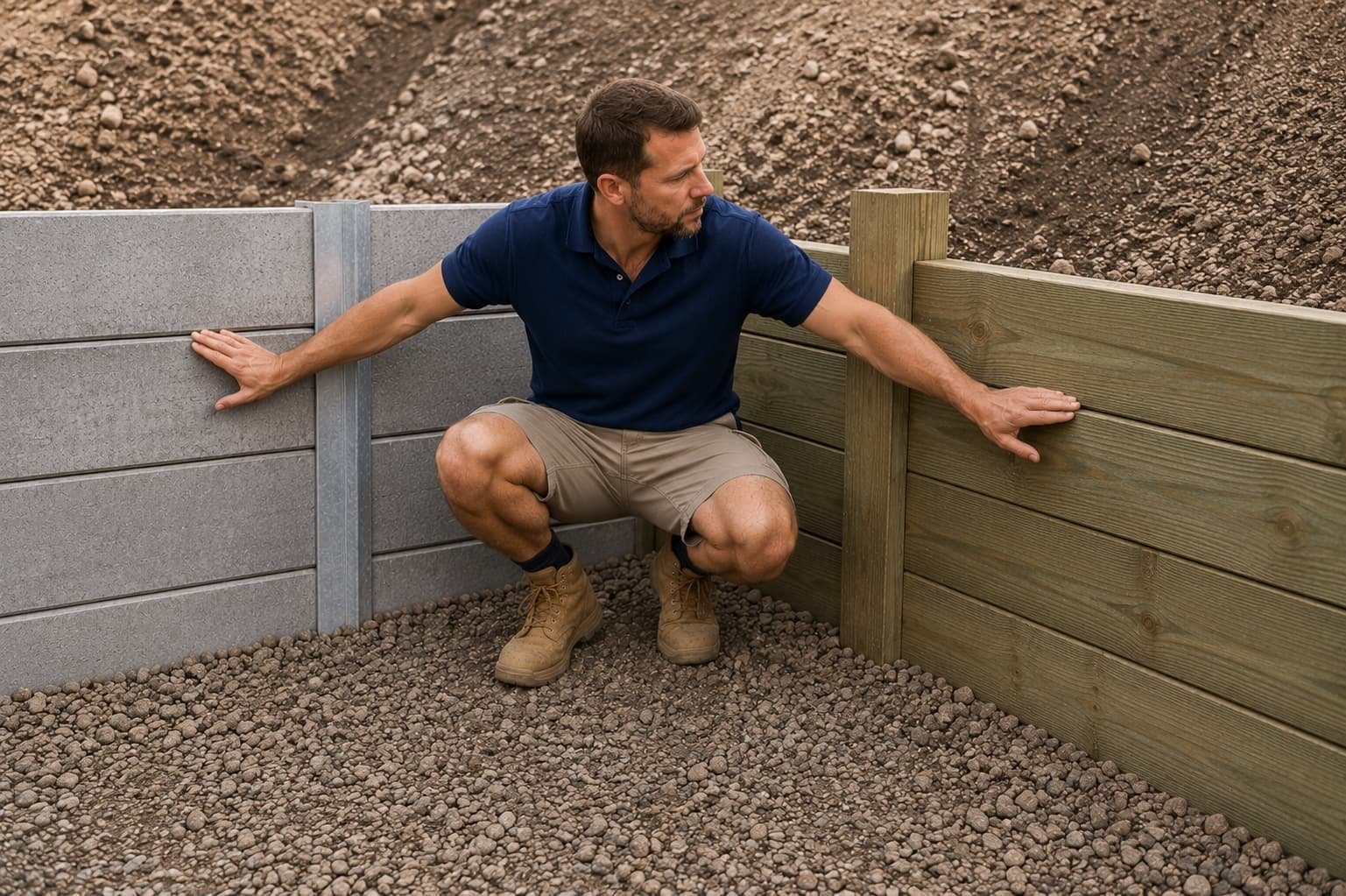
Concrete vs timber sleeper is the choice almost every Cairns homeowner faces when they plan a retaining wall, and in this climate it’s a decision worth getting right. Both are proven sleeper systems that slot between posts and do the same basic job — but heat, heavy wet-season rain and termites push the two materials in different directions here. Here’s an honest comparison to help you pick the right one for your block.
Timber Sleeper Walls: Pros and Cons
Timber is the budget-friendly, natural-looking option, and for the right job it’s a great choice.
- Pros: lower cost, a warm natural finish that suits gardens, and quick to build for lower walls and terracing.
- Cons: a shorter lifespan in the tropics. Even H4-treated hardwood eventually gives way to Cairns’s heat, moisture and termite pressure — typically 15 to 20 years with good drainage, less without it.
Timber earns its place on lower garden walls where budget and looks matter more than maximum lifespan. The key is H4 treatment and real drainage — a cheap, poorly drained timber wall is the one that fails early. It’s also worth remembering that timber weathers and can need the odd board replaced over the years, so it’s a slightly more hands-on wall to own.
Concrete Sleeper Walls: Pros and Cons
Concrete is the stronger, longer-lasting option, and it’s our most popular pick for Cairns conditions.
- Pros: lasts for decades, won’t rot, warp or fall to termites, and handles taller and heavier-loaded walls with ease. Precast sleepers give a clean, consistent finish and effectively no ongoing maintenance.
- Cons: costs more up front than timber, and the look is more structural than natural (though many people prefer the crisp, modern line).
For hillside blocks, taller walls, anything carrying load, or simply a wall you want to build once and forget, concrete sleepers are hard to beat in this climate.
Concrete vs Timber Sleeper: Which Wins in the Cairns Climate?
On pure durability, concrete wins for the tropics — the combination of monsoon rain and termite pressure is exactly what shortens a timber wall’s life, and concrete shrugs both off. That said, “best” depends on the job. A metre-plus wall holding a Redlynch or Whitfield hillside should almost always be concrete or block; a low garden wall on a flat block where you want a natural look and a smaller spend is a perfectly good timber job. Whichever you choose, if the wall goes over a metre or carries load it must be engineered to meet the National Construction Code published by the ABCB — the material doesn’t change that requirement.
Cost Comparison
Price is usually the tiebreaker. As a supplied-and-installed guide (GST inclusive), timber sleeper walls run roughly A$250 to A$450 per square metre, while concrete sleeper walls run roughly A$350 to A$650 per square metre. Timber is cheaper today; concrete often works out better value over the life of the wall because it lasts so much longer. For a fuller breakdown, see our guide to retaining wall cost in Cairns.
Our Recommendation for Cairns Blocks
There’s no single right answer — it comes down to your block, your budget and how long you want the wall to last. As a rule of thumb: go concrete for hillside blocks, taller or load-bearing walls, and anywhere you want maximum lifespan; go timber for lower garden walls where a natural look and a lower price win. We’ll always give you a straight recommendation based on what your site actually needs, not what’s easiest to sell. And if a besser block or rock wall is genuinely the better fit for your block, we’ll tell you that too.
Still weighing it up? We’re happy to look at your block and tell you honestly which way to go. Get in touch for a free, no-obligation quote and we’ll help you make the right call.